# Kingfisher
 [](https://opensource.org/licenses/Apache-2.0)
Kingfisher is a blazingly fast secret‑scanning and live validation tool built in Rust. It combines Intel’s hardware‑accelerated Hyperscan regex engine with language‑aware parsing via Tree‑Sitter, and **ships with hundreds of built‑in rules** to detect, validate, and triage secrets before they ever reach production
[](https://opensource.org/licenses/Apache-2.0)
Kingfisher is a blazingly fast secret‑scanning and live validation tool built in Rust. It combines Intel’s hardware‑accelerated Hyperscan regex engine with language‑aware parsing via Tree‑Sitter, and **ships with hundreds of built‑in rules** to detect, validate, and triage secrets before they ever reach production
Kingfisher originated as a fork of Praetorian's Nosey Parker, and is built atop their incredible work and the work contributed by the Nosey Parker community.
## What Kingfisher Adds
- **Live validation** via cloud-provider APIs
- **Extra targets**: GitLab repos, S3 buckets, Docker images, Jira issues, Confluence pages, and Slack messages
- **Compressed Files**: Supports extracting and scanning compressed files for secrets
- **Baseline mode**: ignore known secrets, flag only new ones
- **Allowlist support**: suppress false positives with custom regexes or words
- **Language-aware detection** (source-code parsing) for ~20 languages
- **Native Windows** binary
## Key Features
- **Performance**: multithreaded, Hyperscan‑powered scanning built for huge codebases
- **Extensible rules**: hundreds of built-in detectors plus YAML-defined custom rules ([docs/RULES.md](/docs/RULES.md))
- **Multiple targets**:
- **Git history**: local repos or GitHub/GitLab orgs/users
- **Repository artifacts**: with `--repo-artifacts`, scan GitHub/GitLab repository artifacts such as issues, pull/merge requests, wikis, snippets, and owner gists in addition to code
- **Docker images**: public or private via `--docker-image`
- **Jira issues**: JQL‑driven scans with `--jira-url` and `--jql`
- **Confluence pages**: CQL‑driven scans with `--confluence-url` and `--cql`
- **Slack messages**: query‑based scans with `--slack-query`
- **AWS S3**: bucket scans via `--s3-bucket`/`--s3-prefix` with credentials from `KF_AWS_KEY`/`KF_AWS_SECRET`, `--role-arn`, `--aws-local-profile`, or anonymous
- **Compressed Files**: Supports extracting and scanning compressed files for secrets
- **Baseline management**: generate and track baselines to suppress known secrets ([docs/BASELINE.md](/docs/BASELINE.md))
**Learn more:** [Introducing Kingfisher: Real‑Time Secret Detection and Validation](https://www.mongodb.com/blog/post/product-release-announcements/introducing-kingfisher-real-time-secret-detection-validation)
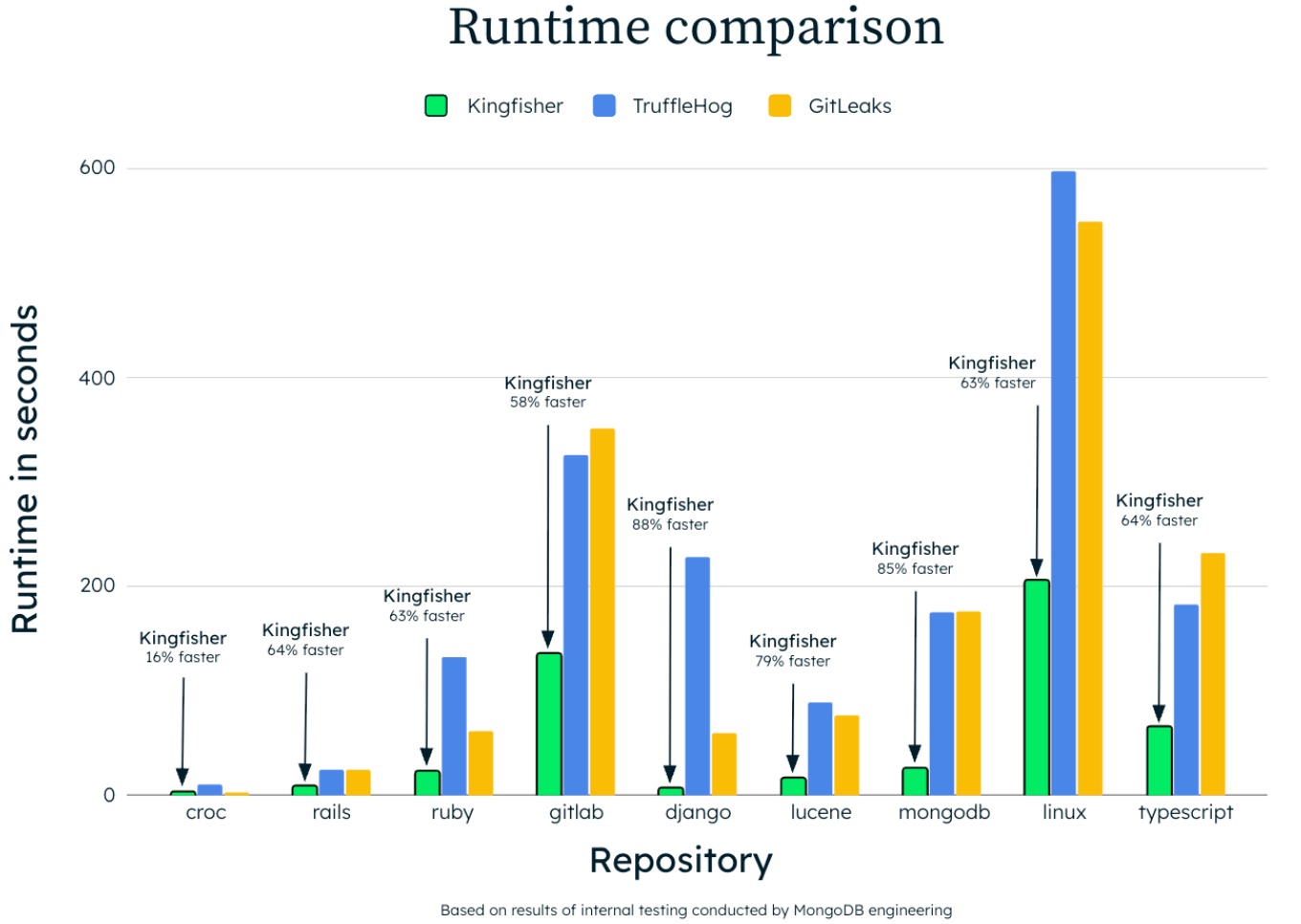
# Benchmark Results
See ([docs/COMPARISON.md](docs/COMPARISON.md))
# Getting Started
## Installation
On macOS, you can simply
```bash
brew install kingfisher
```
Pre-built binaries are also available on the [Releases](https://github.com/mongodb/kingfisher/releases) section of this page.
You can also install using [ubi](https://github.com/houseabsolute/ubi), which downloads the correct binary for your platform:
```bash
# Linux, macOS
curl --silent --location \
https://raw.githubusercontent.com/houseabsolute/ubi/master/bootstrap/bootstrap-ubi.sh | \
sh && \
ubi --project mongodb/kingfisher --in "$HOME/bin"
```
```powershell
# Windows
powershell -exec bypass -c "Invoke-WebRequest -URI 'https://raw.githubusercontent.com/houseabsolute/ubi/master/bootstrap/bootstrap-ubi.ps1' -UseBasicParsing | Invoke-Expression" && ubi --project mongodb/kingfisher --in .
```
This installs `ubi` and then places the `kingfisher` executable in `~/bin` on Unix-like
systems (or the current directory on Windows).
Or you may compile for your platform via `make`:
```bash
# NOTE: Requires Docker
make linux
# macOS --- must build from a macOS host
make darwin
# Windows x64 --- requires building from a Windows host with Visual Studio installed
./buildwin.bat -force
```
```bash
# Build all targets
make linux-all # builds both x64 and arm64
make darwin-all # builds both x64 and arm64
make all # builds for every OS and architecture supported
```
### Install as a Git pre-commit hook
Run `kingfisher precommit --install` to set up a Git pre-commit hook that runs
`kingfisher scan --quiet --only-valid --no-update-check` before each commit.
Use `--global` to operate on all repositories or `--repo` to target only the
current repository without prompting. Remove the hook with
`kingfisher precommit --remove`.
### Run Kingfisher in Docker
Run the dockerized Kingfisher container:
```bash
# GitHub Container Registry
docker run --rm ghcr.io/mongodb/kingfisher:latest --version
# Scan the current working directory
# (mounts your code at /src and scans it)
docker run --rm \
-v "$PWD":/src \
ghcr.io/mongodb/kingfisher:latest scan /src
# Scan while providing a GitHub token
# Mounts your working dir at /proj and passes in the token:
docker run --rm \
-e KF_GITHUB_TOKEN=ghp_… \
-v "$PWD":/proj \
ghcr.io/mongodb/kingfisher:latest \
scan --git-url https://github.com/org/private_repo.git
# Scan an S3 bucket
# Credentials can come from KF_AWS_KEY/KF_AWS_SECRET, --role-arn, or --aws-local-profile
docker run --rm \
-e KF_AWS_KEY=AKIA... \
-e KF_AWS_SECRET=g5nYW... \
ghcr.io/mongodb/kingfisher:latest \
scan --s3-bucket bucket-name
# Scan and write a JSON report locally
# Here we:
# 1. Mount $PWD → /proj
# 2. Tell Kingfisher to write findings.json inside /proj/reports
# 3. Ensure ./reports exists on your host so Docker can mount it
mkdir -p reports
# run and output into host’s ./reports directory
docker run --rm \
-v "$PWD":/proj \
ghcr.io/mongodb/kingfisher:latest \
scan /proj \
--format json \
--output /proj/reports/findings.json
# Tip: you can combine multiple mounts if you prefer separating source vs. output:
# Here /src is read‑only, and /out holds your generated reports
docker run --rm \
-v "$PWD":/src:ro \
-v "$PWD/reports":/out \
ghcr.io/mongodb/kingfisher:latest \
scan /src \
--format json \
--output /out/findings.json
```
# 🔐 Detection Rules at a Glance
Kingfisher ships with hundreds of rules that cover everything from classic cloud keys to the latest LLM-API secrets. Below is an overview:
| Category | What we catch |
|----------|---------------|
| **AI / LLM APIs** | OpenAI, Anthropic, Google Gemini, Cohere, Mistral, Stability AI, Replicate, xAI (Grok), and more
| **Cloud Providers** | AWS, Azure, GCP, Alibaba Cloud, DigitalOcean, IBM Cloud, Cloudflare, and more
| **Dev & CI/CD** | GitHub/GitLab tokens, CircleCI, TravisCI, TeamCity, Docker Hub, npm, PyPI, and more
| **Messaging & Comms** | Slack, Discord, Microsoft Teams, Twilio, Mailgun, SendGrid, Mailchimp, and more
| **Databases & Data Ops** | MongoDB Atlas, PlanetScale, Postgres DSNs, Grafana Cloud, Datadog, Dynatrace, and more
| **Payments & Billing** | Stripe, PayPal, Square, GoCardless, and more
| **Security & DevSecOps** | Snyk, Dependency-Track, CodeClimate, Codacy, OpsGenie, PagerDuty, and more
| **Misc. SaaS & Tools** | 1Password, Adobe, Atlassian/Jira, Asana, Netlify, Baremetrics, and more
## Write Custom Rules!
Kingfisher ships with hundreds of rules with HTTP and service‑specific validation checks (AWS, Azure, GCP, etc.) to confirm if a detected string is a live credential.
However, you may want to add your own custom rules, or modify a detection to better suit your needs / environment.
First, review [docs/RULES.md](/docs/RULES.md) to learn how to create custom Kingfisher rules.
Once you've done that, you can provide your custom rules (defined in a YAML file) and provide it to Kingfisher at runtime --- no recompiling required!
# Usage
## Basic Examples
> **Note** `kingfisher scan` detects whether the input is a Git repository or a plain directory, no extra flags required.
### Scan with secret validation
```bash
kingfisher scan /path/to/code
## NOTE: This path can refer to:
# 1. a local git repo
# 2. a directory with many git repos
# 3. or just a folder with files and subdirectories
## To explicitly prevent scanning git commit history add:
# `--git-history=none`
```
### Scan a directory containing multiple Git repositories
```bash
kingfisher scan /projects/mono‑repo‑dir
```
### Scan a Git repository without validation
```bash
kingfisher scan ~/src/myrepo --no-validate
```
### Display only secrets confirmed active by third‑party APIs
```bash
kingfisher scan /path/to/repo --only-valid
```
### Output JSON and capture to a file
```bash
kingfisher scan . --format json | tee kingfisher.json
```
### Output SARIF directly to disk
```bash
kingfisher scan /path/to/repo --format sarif --output findings.sarif
```
### Pipe any text directly into Kingfisher by passing `-`
```bash
cat /path/to/file.py | kingfisher scan -
```
### Scan using a rule _family_ with one flag
_(prefix matching: `--rule kingfisher.aws` loads `kingfisher.aws._`)\*
```bash
# Only apply AWS-related rules (kingfisher.aws.1 + kingfisher.aws.2)
kingfisher scan /path/to/repo --rule kingfisher.aws
```
### Display rule performance statistics
```bash
kingfisher scan /path/to/repo --rule-stats
```
### Scan while ignoring likely test files
`--exclude` skips any file or directory whose path matches this glob pattern (repeatable, uses gitignore-style syntax, case sensitive)
```bash
# Scan source but skip likely unit / integration tests
kingfisher scan ./my-project \
--exclude='[Tt]est' \
--exclude='spec' \
--exclude='[Ff]ixture' \
--exclude='example' \
--exclude='sample'
```
### Exclude specific paths
```bash
# Skip all Python files and any directory named tests
kingfisher scan ./my-project \
--exclude '*.py' \
--exclude '[Tt]ests'
```
If you want to know which files are being skipped, enable verbose debugging (-v) when scanning, which will report any files being skipped by the baseline file (or via --exclude):
```bash
# Skip all Python files and any directory named tests, and report to stderr any skipped files
kingfisher scan ./my-project \
--exclude '*.py' \
--exclude tests \
-v
```
## Scan an S3 bucket
You can scan S3 objects directly:
```bash
kingfisher scan --s3-bucket bucket-name [--s3-prefix path/]
```
Credential resolution happens in this order:
1. `KF_AWS_KEY` and `KF_AWS_SECRET` environment variables
2. `--aws-local-profile` pointing to a profile in `~/.aws/config` (works with AWS SSO)
3. anonymous access for public buckets
If `--role-arn` is supplied, the credentials from steps 1–2 are used to assume that role.
Examples:
```bash
# using explicit keys
export KF_AWS_KEY=AKIA...
export KF_AWS_SECRET=g5nYW...
kingfisher scan --s3-bucket some-example-bucket
# Above can also be run as:
KF_AWS_KEY=AKIA... KF_AWS_SECRET=g5nYW... kingfisher scan --s3-bucket some-example-bucket
# using a local profile (e.g., SSO) that exists in your AWS profile (~/.aws/config)
kingfisher scan --s3-bucket some-example-bucket --aws-local-profile default
# anonymous scan of a bucket, while providing an object prefix to only scan subset of the s3 bucket
kingfisher scan \
--s3-bucket awsglue-datasets \
--s3-prefix examples/us-legislators/all
# assuming a role when scanning
kingfisher scan --s3-bucket some-example-bucket \
--role-arn arn:aws:iam::123456789012:role/MyRole
# anonymous scan of a public bucket
kingfisher scan --s3-bucket some-example-bucket
```
Docker example:
```bash
docker run --rm \
-e KF_AWS_KEY=AKIA... \
-e KF_AWS_SECRET=g5nYW... \
ghcr.io/mongodb/kingfisher:latest \
scan --s3-bucket bucket-name
```
## Scanning Docker Images
Kingfisher will first try to use any locally available image, then fall back to pulling via OCI.
Authentication happens *in this order*:
1. **`KF_DOCKER_TOKEN`** env var
- If it contains `user:pass`, it’s used as Basic auth
- Otherwise it’s sent as a Bearer token
2. **Docker CLI credentials**
- Checks `credHelpers` (per-registry) and `credsStore` in `~/.docker/config.json`.
- Falls back to the legacy `auths` → `auth` (base64) entries.
3. **Anonymous** (no credentials)
```bash
# 1) Scan public or already-pulled image
kingfisher scan --docker-image ghcr.io/owasp/wrongsecrets/wrongsecrets-master:latest-master
# 2) For private registries, explicitly set KF_DOCKER_TOKEN:
# - Basic auth: "user:pass"
# - Bearer only: "TOKEN"
export KF_DOCKER_TOKEN="AWS:$(aws ecr get-login-password --region us-east-1)"
kingfisher scan --docker-image some-private-registry.dkr.ecr.us-east-1.amazonaws.com/base/amazonlinux2023:latest
# 3) Or rely on your Docker CLI login/keychain:
# (e.g. aws ecr get-login-password … | docker login …)
kingfisher scan --docker-image private.registry.example.com/my-image:tag
```
## Scanning GitHub
### Scan GitHub organisation (requires `KF_GITHUB_TOKEN`)
```bash
kingfisher scan --github-organization my-org
```
### Scan remote GitHub repository
`--git-url` clones the repository and scans its files and history. To also inspect
related server-side data, supply `--repo-artifacts`. This flag pulls down the
repository's issues (including pull requests), wiki, and any public gists owned by
the repository owner and scans them for secrets. Fetching these extras counts
against API rate limits and private artifacts require a `KF_GITHUB_TOKEN`.
```bash
# Scan the repository only
kingfisher scan --git-url https://github.com/org/repo.git
# Include issues, wiki, and owner gists
kingfisher scan --git-url https://github.com/org/repo.git --repo-artifacts
# Private repositories or artifacts
KF_GITHUB_TOKEN="ghp_…" kingfisher scan --git-url https://github.com/org/private_repo.git --repo-artifacts
```
---
## Scanning GitLab
### Scan GitLab group (requires `KF_GITLAB_TOKEN`)
```bash
kingfisher scan --gitlab-group my-group
# include repositories from all nested subgroups
kingfisher scan --gitlab-group my-group --gitlab-include-subgroups
```
### Scan GitLab user
```bash
kingfisher scan --gitlab-user johndoe
```
### Scan remote GitLab repository by URL
`--git-url` by itself clones the project repository. To include server-side
artifacts owned by the project, add `--repo-artifacts`. Kingfisher will retrieve
the project's issues, wiki, and snippets and scan them for secrets. These extra
requests may take longer and require a `KF_GITLAB_TOKEN` for private projects.
```bash
# Scan the repository only
kingfisher scan --git-url https://gitlab.com/group/project.git
# Include issues, wiki, and snippets
kingfisher scan --git-url https://gitlab.com/group/project.git --repo-artifacts
# Private projects or artifacts
KF_GITLAB_TOKEN="glpat-…" kingfisher scan --git-url https://gitlab.com/group/private_project.git --repo-artifacts
```
### List GitLab repositories
```bash
kingfisher gitlab repos list --group my-group
# include repositories from all nested subgroups
kingfisher gitlab repos list --group my-group --include-subgroups
```
## Scanning Jira
### Scan Jira issues matching a JQL query
```bash
KF_JIRA_TOKEN="token" kingfisher scan \
--jira-url https://jira.company.com \
--jql "project = TEST AND status = Open" \
--max-results 500
```
### Scan the last 1,000 Jira issues:
```bash
KF_JIRA_TOKEN="token" kingfisher scan \
--jira-url https://jira.mongodb.org \
--jql 'ORDER BY created DESC' \
--max-results 1000
```
## Scanning Confluence
### Scan Confluence pages matching a CQL query
```bash
# Bearer token
KF_CONFLUENCE_TOKEN="token" kingfisher scan \
--confluence-url https://confluence.company.com \
--cql "label = secret" \
--max-results 500
# Basic auth with username and token
KF_CONFLUENCE_USER="user@example.com" KF_CONFLUENCE_TOKEN="token" kingfisher scan \
--confluence-url https://confluence.company.com \
--cql "text ~ 'password'" \
--max-results 500
```
Use the base URL of your Confluence site for `--confluence-url`. Kingfisher
automatically adds `/rest/api` to the end, so `https://example.com/wiki` and
`https://example.com` both work depending on your server configuration.
Generate a personal access token and set it in the `KF_CONFLUENCE_TOKEN` environment variable. By default, Kingfisher sends the token as a bearer token in the `Authorization` header.
To use basic authentication instead, also set `KF_CONFLUENCE_USER` to your Confluence email address; Kingfisher will then send the username and `KF_CONFLUENCE_TOKEN` as a Basic auth header. If the server responds with a redirect to a login page, the credentials are invalid or lack the required permissions.
## Scanning Slack
### Scan Slack messages matching a search query
```bash
KF_SLACK_TOKEN="xoxp-1234..." kingfisher scan \
--slack-query "from:username has:link" \
--max-results 1000
KF_SLACK_TOKEN="xoxp-1234..." kingfisher scan \
--slack-query "akia" \
--max-results 1000
```
*The Slack token must be a user token with the `search:read` scope. Bot tokens (those beginning with `xoxb-`) cannot call the Slack search API.*
## Environment Variables for Tokens
| Variable | Purpose |
| ----------------- | ---------------------------- |
| `KF_GITHUB_TOKEN` | GitHub Personal Access Token |
| `KF_GITLAB_TOKEN` | GitLab Personal Access Token |
| `KF_JIRA_TOKEN` | Jira API token |
| `KF_CONFLUENCE_TOKEN` | Confluence API token |
| `KF_SLACK_TOKEN` | Slack API token |
| `KF_DOCKER_TOKEN` | Docker registry token (`user:pass` or bearer token). If unset, credentials from the Docker keychain are used |
| `KF_AWS_KEY` and `KF_AWS_SECRET` | AWS Credentials to use with S3 bucket scanning |
Set them temporarily per command:
```bash
KF_GITLAB_TOKEN="glpat-…" kingfisher scan --gitlab-group my-group
```
Or export for the session:
```bash
export KF_GITLAB_TOKEN="glpat-…"
```
To authenticate Jira requests:
```bash
export KF_JIRA_TOKEN="token"
```
To authenticate Confluence requests:
```bash
export KF_CONFLUENCE_TOKEN="token"
```
_If no token is provided Kingfisher still works for public repositories._
---
## Exit Codes
| Code | Meaning |
| ---- | ----------------------------- |
| 0 | No findings |
| 200 | Findings discovered |
| 205 | Validated findings discovered |
## Update Checks
Kingfisher automatically queries GitHub for a newer release when it starts and tells you whether an update is available.
- **Hands-free updates** – Add `--self-update` to any Kingfisher command
* If a newer version exists, Kingfisher will download it, replace the running binary, and re-launch itself with the **exact same arguments**.
* If the update fails or no newer release is found, the current run proceeds as normal
- **Disable version checks** – Pass `--no-update-check` to skip both the startup and shutdown checks entirely
# Advanced Options
## Build a Baseline / Detect New Secrets
There are situations where a repository already contains checked‑in secrets, but you want to ensure no **new** secrets are introduced. A baseline file lets you document the known findings so future scans only report anything that is not already in that list.
The easiest way to create a baseline is to run a normal scan with the `--manage-baseline` flag (typically at a low confidence level to capture all potential matches):
```bash
kingfisher scan /path/to/code \
--confidence low \
--manage-baseline \
--baseline-file ./baseline-file.yml
```
Use the same YAML file with the `--baseline-file` option on future scans to hide all recorded findings:
```bash
kingfisher scan /path/to/code \
--baseline-file /path/to/baseline-file.yaml
```
Running the scan again with `--manage-baseline` refreshes the baseline by adding new findings and pruning entries for secrets that no longer appear. See [docs/BASELINE.md](docs/BASELINE.md) for full detail.
## List Builtin Rules
```bash
kingfisher rules list
```
## To scan using **only** your own `my_rules.yaml` you could run:
```bash
kingfisher scan \
--load-builtins=false \
--rules-path path/to/my_rules.yaml \
./src/
```
## To add your rules alongside the built‑ins:
```bash
kingfisher scan \
--rules-path ./custom-rules/ \
--rules-path my_rules.yml \
~/path/to/project-dir/
```
## Other Examples
```bash
# Check custom rules - this ensures all regular expressions compile, and can match the rule's `examples` in the YML file
kingfisher rules check --rules-path ./my_rules.yml
# List GitHub repos
kingfisher github repos list --user my-user
kingfisher github repos list --organization my-org
```
## Notable Scan Options
- `--no-dedup`: Report every occurrence of a finding (disable the default de-duplicate behavior)
- `--confidence `: (low|medium|high)
- `--min-entropy `: Override default threshold
- `--no-binary`: Skip binary files
- `--no-extract-archives`: Do not scan inside archives
- `--extraction-depth `: Specifies how deep nested archives should be extracted and scanned (default: 2)
- `--redact`: Replaces discovered secrets with a one-way hash for secure output
- `--exclude `: Skip any file or directory whose path matches this glob pattern (repeatable, uses gitignore-style syntax, case sensitive)
- `--baseline-file `: Ignore matches listed in a baseline YAML file
- `--manage-baseline`: Create or update the baseline file with current findings
- `--skip-regex `: Ignore findings whose text matches this regex (repeatable)
- `--skip-word `: Ignore findings containing this case-insensitive word (repeatable)
### Ignore known false positives
Use `--skip-regex` and `--skip-word` to suppress findings you know are benign. Both flags may be provided multiple times and are tested against the secret value **and** the full match context.
With `--skip-regex`, these should be Rust compatible regular expressions, which you can test out at [regex101](https://regex101.com)
```bash
# Skip any finding where the finding mentions TEST_KEY
kingfisher scan --skip-regex '(?i)TEST_KEY' path/
# Skip findings that contain the word "dummy" anywhere in the match
kingfisher scan --skip-word dummy path/
# Combine multiple patterns
kingfisher scan \
--skip-regex 'AKIA[0-9A-Z]{16}' \
--skip-word placeholder \
--skip-word dummy \
path/
```
If a `--skip-regex` regular expression fails to compile, the scan aborts with an error so that typos are caught early.
## Finding Fingerprint
The document below details the four-field formula (rule SHA-1, origin label, start & end offsets) hashed with XXH3-64 to create Kingfisher’s 64-bit finding fingerprint, and explains how this ID powers safe deduplication; plus how `--no-dedup` can be used shows every raw match.
See ([docs/FINGERPRINT.md](docs/FINGERPRINT.md))
## Rule Performance Profiling
Use `--rule-stats` to collect timing information for every rule. After scanning, the summary prints a **Rule Performance Stats** section showing how many matches each rule produced along with its slowest and average match times. Useful when creating rules or debugging rules.
## CLI Options
```bash
kingfisher scan --help
```
# Roadmap
- More rules
- More targets
- Please file a [feature request](https://github.com/mongodb/kingfisher/issues), or open a PR, if you have features you'd like added
# License
[Apache2 License](LICENSE)